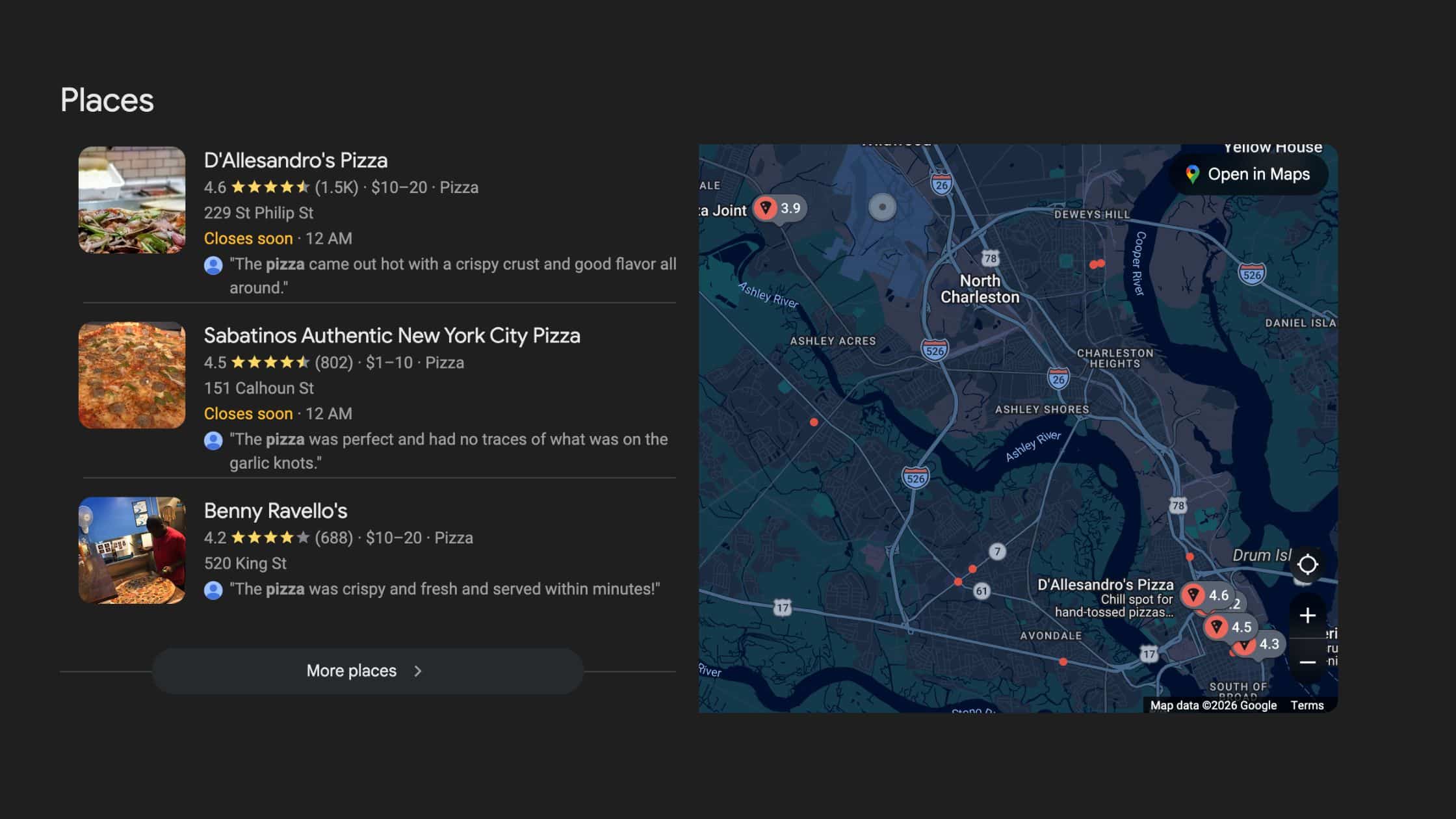
The Google map pack — those three local business listings that appear at the top of a search results page alongside a map — is some of the most valuable real estate in local search.
When someone searches “web designer near me” or “coffee shop in Sumter” or “plumber open now,” the map pack is the first thing they see. It captures the majority of clicks for local searches. If your business isn’t in it, you’re invisible to a large portion of people who are actively looking for what you offer — not browsing, not comparing, actively looking.
So how does Google decide who gets those three spots? And what can you actually do to improve your chances? That’s what this post is about.
If you haven’t set up your Google Business Profile yet, start with our main guide: Your Google Business Profile Is Free Real Estate — Here’s How to Actually Use It. This post picks up from there and goes deeper on the specific factors that influence map pack placement.
How Google’s Local Algorithm Works
Google uses three primary factors to determine which businesses show up in the map pack. Understanding these isn’t just useful — it tells you exactly where to focus your effort.
Relevance is how well your business matches what someone is searching for. This is influenced by your primary business category, your description, the services you’ve listed, the keywords present throughout your profile, and the relevance of your website to the search query. If someone searches “web designer Sumter SC” and your profile doesn’t clearly communicate that you’re a web designer in Sumter, Google has no strong reason to show you.
Distance is how close your business is to the person searching, or to the location they specified in their search. You can’t move your business to improve this factor — but you can make sure your address is accurate and consistent everywhere online, and that your service area is clearly defined if you’re a service-area business.
Prominence is how well-known and trusted your business is — both online and in the real world. Google assesses this through your review count and rating, how many legitimate online directories list your business (citations), whether other websites link to you, and how active and complete your GBP profile is.
Most businesses have limited direct control over distance. The biggest opportunities — and the biggest gaps between businesses that show up and those that don’t — are in relevance and prominence. Both are very much within your control.
Relevance + Prominence = your controllable map pack advantage. Distance is fixed. These two are not.
Start With Profile Completeness
Google has stated directly that complete profiles are more likely to show up in local search results. Every empty field in your GBP is a missed signal — a gap where a competitor’s complete profile has an advantage over yours.
Go through your profile carefully and make sure you have:
- A specific, accurate primary category — and secondary categories where applicable. “Web Designer” beats “Technology Company.” The more specific, the more relevant your profile becomes for targeted searches.
- A fully written business description using natural, readable language that describes what you do, who you serve, and what makes your business worth choosing. Work your focus keywords in naturally — don’t force them.
- All services listed individually with descriptions. This gives Google more surface area to match your profile to specific searches.
- Accurate, up-to-date hours — including holiday hours and any temporary changes. Google will flag profiles with potentially inaccurate hours, which hurts your standing.
- A working, relevant website link. Google looks at your website as part of evaluating your profile.
- At least ten photos, with new ones added regularly. Profile completeness includes visual content.
- All applicable attributes filled in — veteran-owned, women-led, free Wi-Fi, wheelchair accessible, and any others that honestly apply.
Completeness alone won’t guarantee map pack placement. But incompleteness will almost certainly keep you out of it — or limit how often you appear — regardless of how strong the rest of your profile is.
Reviews Matter More Than Most People Think
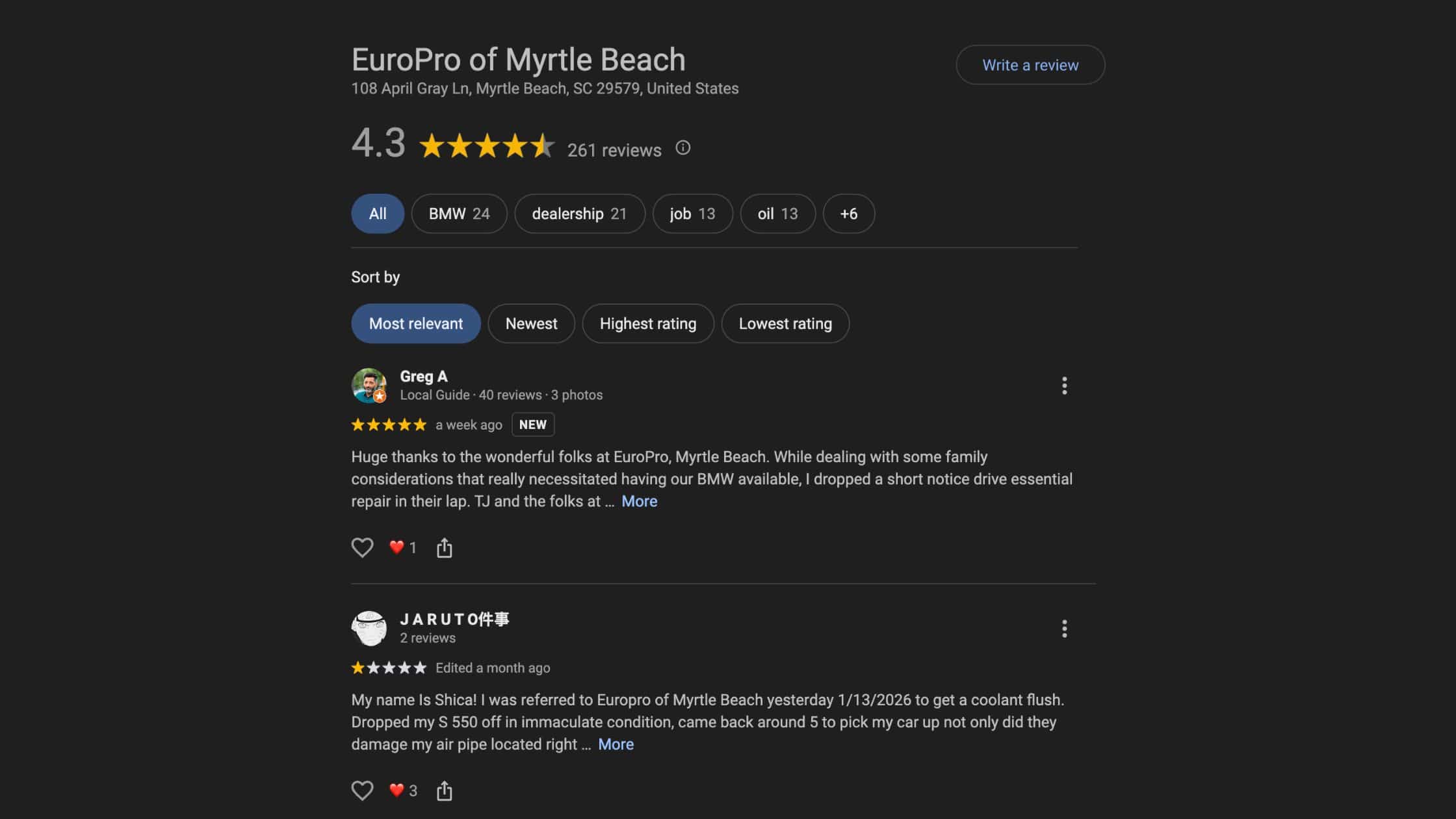
Your review count, your average rating, and how recently you’ve received reviews are all signals Google uses to determine prominence. They’re also one of the most significant and most neglected ranking factors for local search.
A business with forty reviews and a 4.7 rating will generally outrank a business with three reviews and a 4.9 — all else being equal. Volume and recency carry weight alongside quality. A steady stream of recent reviews tells Google your business is active, trusted, and relevant to current customers.
The businesses that consistently show up in the map pack are almost always the ones with the most reviews in their category — and they got there by asking consistently, not by getting lucky.
Build a simple system: after a job is completed, a service is delivered, or a transaction is finished — ask. Google provides a shareable review link directly from your GBP dashboard. Text it. Email it. Put it on your invoice. The ask itself takes thirty seconds. The cumulative effect over months and years is substantial.
Responding to reviews — every single one, positive and negative — also signals to Google that you’re engaged. An owner who responds to reviews is an owner who’s paying attention. That matters.
For a complete review strategy including how to handle negative reviews professionally, see Micro-Blog #2: “The Right Way to Handle Google Reviews (Good and Bad).”
NAP Consistency Across the Web
Your business’s Name, Address, and Phone number — referred to as NAP — need to be identical everywhere they appear online. Your website, Yelp, Facebook, the local Chamber of Commerce directory, Apple Maps, industry-specific directories, local news sites — everywhere.
Even small inconsistencies create conflicting signals. An old phone number on an outdated Yelp listing. An abbreviated street address on one directory and a spelled-out version on another. A business name with “LLC” in one place and without it in another. These discrepancies tell Google’s algorithm that it can’t be fully confident about who your business is and where it’s located — and that uncertainty hurts your local rankings.
Auditing your NAP consistency is worth the time investment. Search your business name and address across the major directories and fix anything that doesn’t match exactly what’s on your website and GBP.
Beyond fixing inconsistencies, getting listed on additional reputable directories — what’s called building local citations — is a legitimate and meaningful way to improve prominence. Every new citation from a trustworthy source is another confirmation to Google that your business is real, established, and operating where you say it is.
Post Regularly on Your Profile
GBP posts are a direct activity signal to Google. A profile that hasn’t had a post in four months looks dormant. A profile that posts weekly looks engaged and active — and Google’s algorithm treats those two profiles differently.
The good news: you don’t need to post daily, or even frequently. Once a week is more than enough to maintain an active signal. The posts themselves can be short and simple — a useful tip, a completed project highlight, a seasonal offer, a link to your latest article, a question you get asked often. Content type matters less than consistency.
One thing to keep in mind: GBP posts expire after approximately seven days. That’s part of why a burst of ten posts followed by three months of silence doesn’t work as well as one steady post per week. Consistency is the variable that matters.
For specific post ideas, formats, and a simple weekly posting habit you can actually stick to, see Micro-Blog #3: “What to Post on Your Google Business Profile — And How Often.”
Your Website and GBP Work Together
Google doesn’t evaluate your GBP in isolation. It looks at your website too — whether the information is consistent with your profile, whether the site is optimized for local keywords, whether it’s technically healthy and fast, and whether it’s a credible, high-quality resource.
A strong website reinforces your GBP and gives Google additional confidence that your business is legitimate and relevant. A weak, outdated, or slow website can hold your local rankings back even if your profile is excellent. The two pieces aren’t separate — they’re part of the same signal set Google uses to evaluate your business.
Make sure the basics are in place: your business name, address, and phone number on your website match your GBP exactly. Your homepage and any relevant service pages mention the location you serve. Your site loads quickly on mobile. There are no broken links or outdated information.
If your website needs work, that’s worth addressing — not just for local rankings, but for the overall impression you make when someone does click through from your GBP listing. For a clear picture of where your site stands, run a free SEO audit through our local SEO services page.
What Happens When You Get All of This Right
The businesses that dominate the map pack in their area aren’t necessarily the best at what they do — though many are. They’re usually the ones who showed up consistently: a complete, accurate profile, regular posts, a steady stream of reviews with professional responses, a website that reinforces the profile, and NAP information that’s consistent everywhere it appears.
None of these things are complicated. But most businesses don’t do all of them consistently. The ones that do build a compounding advantage over time. Their review count grows. Their profile matures. Their citations accumulate. And Google increasingly favors them in local results because the evidence keeps stacking up that they’re a real, active, well-regarded business.
That’s a system. And systems are repeatable — which means this isn’t just about winning the map pack once. It’s about holding that position because you’ve earned it and keep earning it.
If you’d rather have someone manage the optimization and ongoing maintenance while you focus on your business, that’s exactly what we do. Visit our Google Business Profile management service page or reach out at (803) 386-0380.
Frequently Asked Questions
What is the Google map pack?
The map pack is the block of three local business listings that appears at the top of Google search results alongside a map. It captures the majority of clicks for local searches — often more than the organic results below it. Appearing in those three spots is one of the most valuable visibility wins available to a local business.
What are the three factors Google uses for local rankings?
Google uses relevance (how well your profile matches the search), distance (proximity to the searcher), and prominence (how well-known and trusted your business is online). Relevance and prominence are within your control. Distance is fixed based on your location.
How important are Google reviews for map pack rankings?
Very important. Review count, average rating, and recency all signal prominence to Google. Businesses that ask consistently for reviews — and respond to all of them — tend to outperform those that don’t, even when other factors are similar.
What is NAP consistency and why does it matter?
NAP stands for Name, Address, and Phone number. It needs to be identical everywhere your business appears online. Even small inconsistencies — an old phone number, a slightly different business name format — create conflicting signals that can suppress your local rankings.
How long does it take to show up in the map pack?
There’s no fixed timeline. Some businesses see movement within a few weeks of improving their profile and consistency. More competitive markets or categories may take a few months. The key is starting and staying consistent — local authority builds over time.