SEO and SEM are two marketing terms that get used interchangeably, usually without anyone explaining how they differ. Both are about showing up when people search, but they get you there in very different ways, and knowing the difference helps you spend your marketing budget wisely.
The short version
- SEO (search engine optimization) earns you a spot in the free, organic search results and the map results by making your website and Google Business Profile the best answer for a search.
- SEM (search engine marketing) is used a couple of ways, but most people mean paid search: buying ads that appear at the top of search results, like Google Ads.
SEO is like building a reputation in your town. SEM is like renting a billboard. Both can bring in customers, but one keeps working after you stop paying and the other doesn’t.
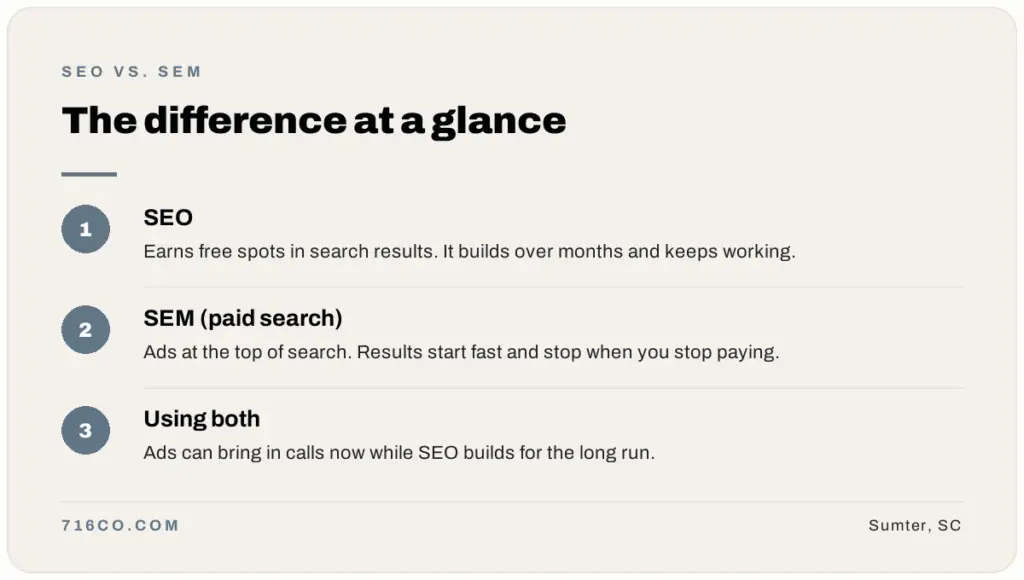
SEO vs. SEM at a glance
| SEO | SEM (paid search) | |
|---|---|---|
| How you show up | Organic results and the map results | Ads marked “Sponsored” at the top of results |
| What you pay for | The work to improve your site and profile | Each click or lead from your ads |
| How fast it works | Builds over a few months | Can start the day ads go live |
| When you stop paying | Rankings keep working for a while | Traffic stops right away |
| Best for | Long-term, steady leads | Quick visibility, launches and seasonal pushes |

What SEO includes
SEO is the work that helps search engines understand your business and trust it enough to show it to people. It usually falls into four areas:
- On-page SEO: page titles, descriptions, headings and content built around what your customers actually search for.
- Technical SEO: site speed, mobile experience, security and structure, so search engines can read and rank your pages.
- Local SEO: your Google Business Profile, reviews and business listings, which decide whether you show up in the map results.
- Off-page SEO: links and mentions from other reputable websites, which build your authority.
In 2026, SEO also helps you show up in AI search tools like Google’s AI Overviews and ChatGPT, which lean on the same signals. (Our guide to ranking for “near me” searches covers the local side step by step.)
What SEM (paid search) includes
Paid search means bidding on the searches you want to show up for and paying when someone clicks your ad. Google Ads is the most common platform, and Microsoft Advertising runs ads on Bing. For many local service businesses, Google’s Local Services Ads are another option: they show up at the very top of some searches and charge per lead instead of per click.
Done well, paid search puts you in front of ready-to-buy customers immediately. Done poorly, it can burn through a budget fast, so it needs careful keyword choices, a good landing page and regular attention.
Which one does your business need?
For most local businesses, SEO is the foundation. It costs less over the long run, builds credibility and keeps bringing in leads month after month. Paid ads also work much better when they send people to a fast, clear website, which is SEO work anyway.
Paid search makes sense on top of that when you need results right away:
- You just opened or launched a new website and don’t rank yet.
- You’re promoting a seasonal service or a limited-time offer.
- Your industry is so competitive that organic results will take a long time to win.
- You want to test which services or keywords bring in the best customers.
The strongest approach for many businesses is both: SEO building long-term visibility while ads fill the gaps.
Frequently asked questions
Is SEO or SEM better for a small business?
u003cpu003eFor most small local businesses, SEO is the better long-term investment because the results keep working after you stop paying. Paid search is useful for quick visibility, launches and seasonal pushes.u003c/pu003e
How long does SEO take compared to ads?
u003cpu003eAds can bring traffic the day they go live. SEO usually shows real movement within a few months and keeps building from there.u003c/pu003e
Does running Google Ads help my organic rankings?
u003cpu003eNo. Google keeps paid ads and organic rankings separate. Ads can bring more people to your site, but they don’t directly improve where you rank in the free results.u003c/pu003e
Not sure where to start? See our SEO plans, or request a free audit and we’ll tell you honestly whether SEO, ads or both make sense for you.