
Local SEO is the set of steps a business takes to show up when nearby customers search on Google, in Google’s AI Overviews, and increasingly in tools like ChatGPT and Perplexity. For a business in Sumter, Manning, Camden, Bishopville, Florence, or Columbia, it comes down to three things: a fully built-out Google Business Profile, consistent activity across reviews and posts, and a website that gives both Google and AI tools a clear, structured answer about who you are and what you do.
This guide covers all of it: the ranking factors Google has used for years, the shift toward active engagement that’s reshaping 2026 results, and what it actually takes to get recommended by AI search tools, not just ranked on a results page.
What Local SEO Actually Means
Local SEO means optimizing your online presence so Google can confidently match your business to a nearby search, then answering that customer’s question well enough that they choose you over the next result. It covers your Google Business Profile, your website, your reviews, and how consistently your business name, address, and phone number appear the same way everywhere online.
Google Still Ranks Local Results on Three Factors
Google has said for years that local rankings come down to relevance, distance, and prominence. That hasn’t changed in 2026. What’s changed is how much weight sits on the third one, and how AI search tools are now layered on top of it.
Relevance
How well your Google Business Profile and website match what someone searched for. A plumber whose profile lists drain cleaning, water heater repair, and emergency service by name is more relevant to “emergency plumber near me” than one that just says “plumbing services.”
Distance
How close your business is to the person searching. You can’t move your shop, but you can make sure your service area is set correctly in your Google Business Profile so you show up for the towns you actually cover, not just the one where your address sits.
Prominence
How well-known and well-regarded your business is, based on reviews, links, citations, and general reputation across the web. This is the factor small businesses have the most control over, and it’s the one worth the most attention.
The Real 2026 Shift: Active Beats Perfect
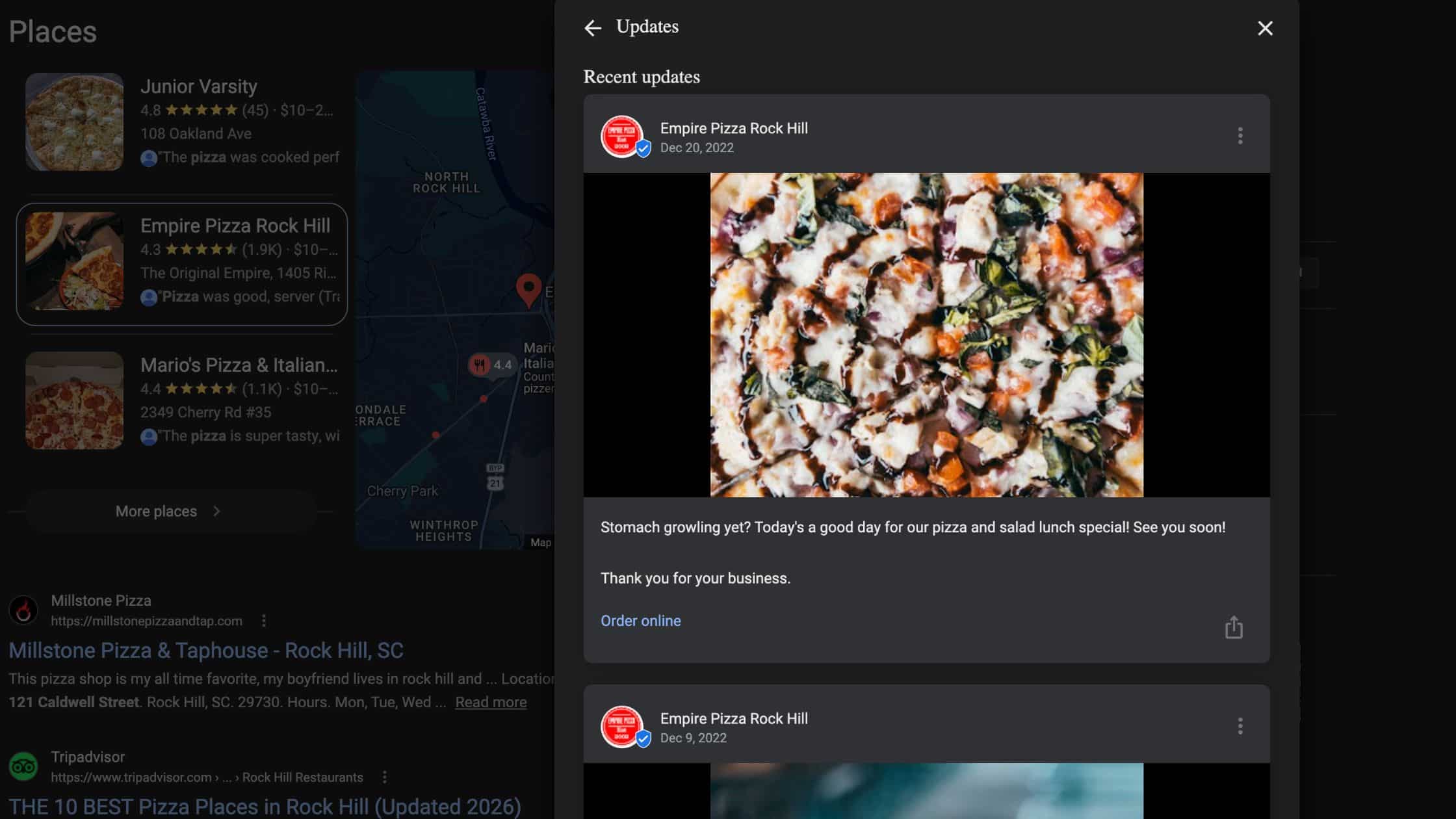
The biggest change in local search isn’t a new ranking factor, it’s a change in what “prominence” rewards. A profile that posts regularly, responds to reviews quickly, and keeps its Q&A section current holds its visibility far better than one that was set up perfectly once and then left alone. Consistency now matters more than any single fix.
That means the businesses pulling ahead in 2026 are doing a handful of small things every month rather than one big project once a year: posting to their Google Business Profile, answering new reviews within a day or two, keeping their Q&A section accurate, and watching for changes in hours, services, or service area.
Getting Into Google’s AI Overviews (This Is AEO)
AEO stands for Answer Engine Optimization: writing and structuring content so it can be pulled directly into an AI-generated answer, whether that’s a Google AI Overview, a voice assistant, or a featured snippet. Instead of ranking a page and hoping someone clicks it, the goal is to have your content quoted as the answer itself.
AI Overviews tend to pull from businesses that already have a strong, recent review profile, clear schema markup on their website, an FAQ section that mirrors real customer questions, and website content thorough enough to fully answer the question rather than just teasing it. A business with three-star reviews and a bare-bones “Contact Us” page is not going to get pulled into an AI answer, no matter how well the rest of its SEO is done.
Getting Recommended by ChatGPT and Perplexity (This Is GEO)
GEO stands for Generative Engine Optimization: making your business easy for AI tools like ChatGPT and Perplexity to find, understand, and recommend when someone asks a question outside of Google entirely, like “who’s a good HVAC company near Sumter, SC.” It runs on the same foundation as AEO, with a few things that matter more.
Write answer-first content. Open each page or section with a direct, two or three sentence answer before going into detail. AI tools are built to answer questions immediately, and they favor content that does the same.
Add schema markup. LocalBusiness schema on your website spells out your location, hours, service area, and review data in a format AI tools can read directly instead of guessing at.
Build real trust signals. Verified reviews, specific service pages instead of one vague page, and a fast, clean website all feed into what’s often called E-E-A-T: experience, expertise, authoritativeness, and trust. AI tools weigh this the same way Google does.
Keep your NAP consistent everywhere. More on that below, since it underpins both AEO and GEO.
The upside is speed. Businesses that clean this up tend to start showing up in AI answers within a couple of months, well ahead of the three to six months traditional Google rankings usually take to move.
Why NAP Consistency Is the Foundation Under All of This
NAP stands for Name, Address, and Phone number, and it needs to match exactly across your website, your Google Business Profile, your Facebook page, and every directory you’re listed in, including the Chamber of Commerce, industry associations, and review sites. A mismatch as small as “Street” versus “St.” or an old suite number left on one listing tells Google, and every AI tool reading the same data, that it can’t fully trust your information.
Run a search of your own business name once a quarter and check what comes up. Old listings from a previous address or a former phone number are more common than most owners expect, especially for businesses that have moved or changed numbers in the last few years.
A Local SEO Checklist for Sumter-Area Businesses
- Claim and fully verify your Google Business Profile, including every applicable service and attribute.
- Set your primary category as specifically as possible, and only add secondary categories you genuinely offer.
- Set your service area to match the towns you actually serve, whether that’s just Sumter or out to Manning, Camden, Bishopville, Florence, and Columbia.
- Post to your Google Business Profile at least twice a month.
- Respond to every review, good or bad, within 48 hours.
- Seed your Q&A section with the five to eight questions customers ask most.
- Add FAQ content and schema markup to your core service pages.
- Check page speed and fix anything that loads slowly on mobile.
- Confirm your NAP matches exactly across your top ten directory listings.
- Build a separate page for each town you serve if you cover more than one, rather than one page trying to rank for all of them.
Common Mistakes That Quietly Hurt Local Rankings
Stuffing extra categories onto a Google Business Profile that don’t actually apply, hoping to show up for more searches. This usually backfires and can trigger a suspension review.
Letting negative reviews sit unanswered. A calm, professional response matters as much to future customers as the review itself.
Going quiet for months at a time. A profile that hasn’t posted, added a photo, or gotten a new review in half a year reads as inactive, both to Google and to a customer scrolling past it.
Skipping schema markup entirely, leaving Google and AI tools to guess at basic facts your website could simply state.
Inconsistent NAP details sitting uncorrected across directories for years.
How Long This Actually Takes
Traditional Google ranking improvements typically take three to six months of consistent work to show up clearly. AI search visibility can move faster, often within a couple of months, once your reviews, schema, and content are in order. Neither happens from a single push. The businesses that hold their position long-term are the ones treating this as a monthly habit rather than a project with an end date.
Why Choose 716 Co.
716 Co. has been designing websites and managing local SEO for small businesses in Sumter, SC since 2009. We specialize in Google Business Profile optimization and auditing, which means the checklist above isn’t theory, it’s the same process we run for our own clients across Sumter, Manning, Camden, Bishopville, Florence, and Columbia. We’ve been recognized with multiple Best of Sumter awards for web design, and we build every project around the same goal covered in this guide: getting found by real customers, on Google and on the AI tools they’re starting to use instead.
Frequently Asked Questions
What is the difference between SEO, AEO, and GEO?
SEO gets your website and Google Business Profile to rank in traditional search results. AEO structures that same content so it can be pulled directly into an AI-generated answer, like a Google AI Overview. GEO extends that further to generative AI tools like ChatGPT and Perplexity that recommend businesses in conversation rather than a list of links. They build on each other rather than replacing one another.
How many Google reviews do I need to rank well locally?
There’s no fixed number, but volume, recency, and your response rate all matter more than hitting a specific count. A business with 30 recent reviews and a 4.7 average, all answered, will typically outperform a competitor with 100 reviews that stopped coming in two years ago.
Do I need schema markup on my website?
Yes, if you want Google and AI tools to read your business details accurately instead of guessing. LocalBusiness and FAQPage schema are the two highest-impact types for a small business site.
How often should I post on my Google Business Profile?
At least twice a month, though weekly is better. What matters most is that the posting stays consistent rather than happening in one big burst and then stopping.
How long does local SEO take to show results?
Plan on three to six months for traditional Google ranking movement, and as little as a couple of months for AI search visibility once your reviews, schema, and content are solid. It’s ongoing work, not a one-time fix.