Most small business owners assume their website is too small to be worth hacking. Unfortunately, that’s backwards. Most attacks are automated: bots crawl the web looking for outdated software and weak logins, and they don’t care whether your site belongs to a national brand or a local church.
The good news is that a few basics stop the vast majority of problems. Here are four ways to secure your website, plus one habit that ties them together.
1. Keep WordPress, themes and plugins updated
Most websites today run on a content management system (CMS) like WordPress, which lets you edit your site without touching code. Like any software, it needs regular updates. Those updates add features, but more importantly, they patch security holes that have been discovered in older versions.
Outdated plugins are one of the most common ways small sites get broken into. To stay ahead of that:
- Check for WordPress, theme and plugin updates at least monthly, and apply security updates right away.
- Back up your site before you update, so you can roll back if something conflicts.
- Delete plugins and themes you aren’t using. Even inactive ones can be a way in.
- Stick with well-supported plugins that are updated regularly.

2. Use an SSL certificate (HTTPS)
An SSL certificate encrypts the connection between your visitor’s browser and your website. It’s what puts the padlock in the address bar and the “s” in https.
Without one, browsers label your site “Not secure,” which is the fastest way to lose a visitor’s trust, and Google favors secure sites in search results. Most good hosting plans now include a free certificate, so there’s no reason to go without. Just make sure it renews automatically, because an expired certificate shows visitors a full-page warning.
3. Add a firewall and monitoring
A web application firewall (WAF) sits between your website and the internet and filters traffic before it reaches your site. It blocks known attack patterns, stops bots that try to guess passwords over and over, and can protect you from new threats before a software update is even available.
Pair it with monitoring so you hear about problems before your customers do:
- Malware scanning checks your site files for anything that shouldn’t be there.
- Uptime monitoring alerts you when your site goes down.
- Security certificate monitoring warns you before your certificate expires.
Ask your hosting company what security features your plan includes. (Here’s what’s included with our website hosting.)
4. Keep automatic backups somewhere else
A backup is your insurance policy. If your site is hacked, an update goes wrong or your server fails, a recent backup turns a disaster into an inconvenience.
- Back up automatically on a schedule. Daily is best for sites that change often, like stores or sites with frequent posts.
- Store backups somewhere other than your web server, so one problem can’t take out both.
- Keep several past versions, not just the latest one.
- Test a restore now and then. A backup you can’t restore isn’t a backup.
Don’t forget the logins
All of the above can be undone by one weak password. Protect the front door too:
- Use a long, unique password for your website and hosting accounts, and store it in a password manager.
- Turn on two-factor authentication for anyone who can log in.
- Give each person their own login, and only as much access as they need.
- Remove accounts for people who no longer work with you.
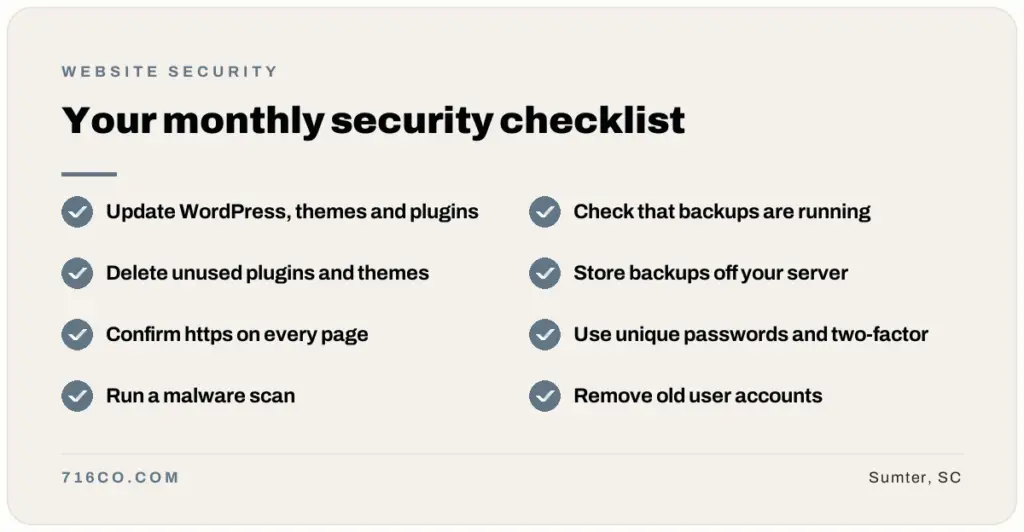
Security is ongoing, not a one-time setup
None of these steps are complicated, but they all have to keep happening. That’s the part most people let slip. If you’d rather not think about it, our website care plans handle updates and backups, and the Pro plan adds uptime, security certificate and vulnerability monitoring. (More on why that matters in why you shouldn’t set it and forget it.)
How to secure your website: frequently asked questions
Can a small website really get hacked?
u003cpu003eYes. Most attacks are automated and go after outdated software and weak passwords, not specific businesses. Small, unmaintained sites are often the easiest targets.u003c/pu003e
How do I know if my website has been hacked?
u003cpu003eCommon signs include Google showing a security warning, visitors being redirected to strange sites, pages you didn’t create, unfamiliar admin accounts, or your host suspending the site. If you see any of these, change your passwords and get help right away.u003c/pu003e
Is a free SSL certificate good enough?
u003cpu003eFor most small business websites, yes. A free certificate encrypts the connection just as well as a paid one. What matters is that it’s installed correctly and renews automatically.u003c/pu003e
Not sure how secure your site is? Request a free website audit, or see our website care plans.